
The WELS dilemma: Why making 4 stars the new minimum may be detrimental
If a customer isn’t happy with the water pressure coming out of their shower or fixture, there’s a chance they’ll tamper with the flow limiter. Andrew Thornthwaite explores other solutions the industry can take.
The Australian Water Efficiency Labelling and Standards (WELS) scheme, introduced in 2005, has been an undeniable success story. The WELS Regulator estimates the WELS Scheme has saved over 1,800 gigalitres (GL) of water, equivalent to 3.6 Sydney Harbours, and delivered billions in utility savings, primarily through efficient technology. Of the scheme’s total benefits, 65% are from energy savings and 35% from water conservation.
WELS’ success has seen it influence consumers’ purchasing decisions by making a higher star rating synonymous with more water-efficient products. Many of us have done it, gone and chosen the fixtures with a higher star rating, even if they’re more expensive, because we want to do our bit to save more water.
Many Australians have also become more mindful about water usage, changing everyday habits like turning off the tap while brushing teeth, limiting sprinkler time, avoiding hosing down paths and shortening shower times. Local water authorities, councils, industry groups and private companies have also contributed significantly to reducing water consumption.
From 3 stars to 4 stars for showers
So, at face value, the discussion to raise the minimum WELS rating for showers from 3 stars to 4 stars, which would reduce the maximum shower flow rate from 9L/min to 7.5L/min, seems like a logical next step: More stars equal more savings.
However, as the old saying goes, history is littered with examples of good theory gone askew.
The “dirty little secret” of flow controllers
Flow rate (measured in L/min) is an important factor for water efficiency in taps and showers. A lower flow rate results in less water being used for the same task in each period, translating into significant water and energy savings.
This reduction in water flow rate is typically achieved by using flow regulators (flow controllers) to maintain a consistent water flow at any pressure. In the past, many showers did not have flow regulators, and the flow rates were often 15L/min or more, whereas now, showers have 9L/min flow regulators or less, saving a huge amount of water, energy and costs.
Raising the minimum WELS standard from 3 to 4 stars would reduce the maximum shower flow rate from 9L/min to 7.5L/min.
No flow regulator: No savings!
It’s long been a dirty little secret in the industry that plumbers and people remove flow regulators to increase water flow for a better shower experience. Remove the flow regulator from showers and the flow rate may increase to 15L/min or more.
If regulations for showers further reduce the maximum allowable flow rate from 9L/min (WELS 3 star) to 7.5L/min (WELS 4 star), the resulting user dissatisfaction with perceived “poor water pressure” (which is in fact often low flow rate) will likely cause more people to simply remove the flow regulators, resulting in higher flow rates.
For example, a friend who upgraded their shower (with a low flow rate) faced immediate complaints from their family about poor water pressure and their plumber simply advised removing the flow controller. Even after warning about higher water usage, possible damage and voided warranties, my friend and their family preferred the better showering experience. This shows that while we all want to do good, we don’t all want to do it at the expense of an enjoyable shower!
We’ve also heard some discussions about making it mandatory for flow regulators to be permanently fixed to showers so they can’t be removed. This is not the answer. Shower components, like any product, may require maintenance from time to time. Flow regulators can get damaged or may need cleaning, so they need to be accessible for cleaning or replacement when necessary.
The important role of auto shut-off (timed flow) and sensor bathroom fixtures
Commercial facilities such as sport and leisure centres, aquatic centres and beachside showers have long reduced water consumption through the use of timed water flow.
Timed-flow and sensor taps and showers work by limiting the water flow time that they flow for and often work by shutting off automatically. Timed flow taps typically run for about seven seconds, while timed sensor showers are typically programmed to run between two and four minutes (for a cubical shower in a sports and leisure centre, as opposed to a rinse shower at the beach or pool deck).
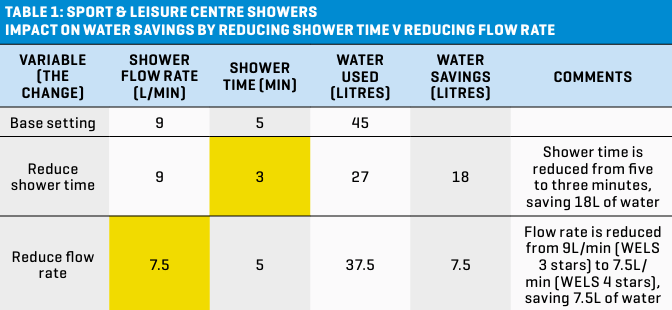
The example below clearly demonstrates that reducing shower time (18L saved) is a significantly more effective way to save water than a small flow rate reduction (7.5L saved). Notably, this development has resulted from practical considerations rather than legislative or regulatory action.
Residential showers
On the residential side, it’s highly unlikely that timed flow taps for basins will ever find their way into residential homes. As such, several water authorities have focused on behavioural change to reduce shower times, such as the Waterwise campaign in South-east Queensland following the 2007 drought and endeavours like the Yarra Water initiative seeking to reduce average shower times from 7 minutes to 4 minutes.
These campaigns could be enhanced by making the regulatory environment more conducive for enabling more timed showers to be available for the residential market, for example, thermostatic shower mixers including those combined with timed flow functionality. Even a modest two-minute reduction in showering time adds up to a lot of saved water.
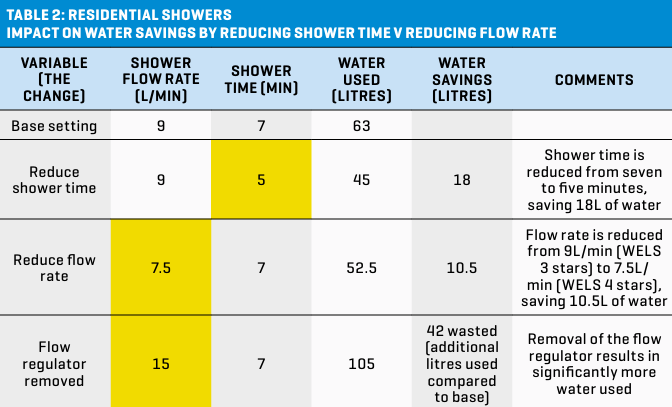
From the above tables, significantly more water is saved by reducing the shower time by two minutes (18L saved) and keeping a comfortable shower, than by reducing the flow rate (10.5L saved). When also considering that industry is getting feedback that many people are removing flow regulators from their showers, if the maximum flow rate is further reduced from 9L/min to 7.5L/min (resulting in a less comfortable shower), more flow regulators will be removed which will often result in flow rates increasing to 15L/min or more, resulting in an additional 42L wasted. The outcome is that more water will be wasted, rather than more water being saved.
Thermostatic shower mixers
Thermostatic shower mixers are another underutilised technology that can save water and energy.
They conserve water and energy by automatically bringing the temperature up to, and keeping it at, the desired water temperature. This eliminates the need for users to wait any longer than needed for the shower to reach the desired temperature and reduces the time spent on temperature adjustments. Some thermostatic shower mixers also incorporate timer functions.
Whilst thermostatic shower mixers are common in other parts of the world for residential use, hotels and other areas, they are not as common in Australia, except for healthcare. Part of the reason is the high cost of getting thermostatic shower mixers modified, tested and certified for use in Australia, as well as how the market has developed locally particularly for the residential market.
As with auto-shut off technology, greater use of thermostatic shower mixers in residential applications is another way to deliver energy and water savings.
Recommendations for improving water efficiency
While we fully support initiatives to further reduce the overall amount of water that showers use, we must also be mindful of the potential for unintended consequences that could undermine our conservation goals.
We fear that pushing for ever-lower flow rates may risk user alienation and inadvertently encourage even more removal of flow regulators by those seeking a better showering experience, resulting in setbacks to the progress we’ve already achieved.
Instead of focusing on chasing reduced shower flow rates that risk regression, industry and policymakers should consider adopting the following approaches: Ones that strike a balance by prioritising the successful implementation of proven, next-generation technologies alongside comprehensive education to foster sustainable long-term water conservation.
This is the big opportunity for policymakers to find a balance between user comfort and water efficiency. Doing so will reduce the number of flow regulators being removed and minimise the number of people going back to full flow showers.
Our recommendations are:
- Maintain the current maximum shower flow rate: Keep the existing maximum allowable flow rate of 9L/min (WELS 3 stars) to ensure a pleasant showering experience, reducing the incentive to remove flow regulators.
- Incentivise auto shut-off technology: Taps already receive an extra WELS star for auto shut-off features. This incentive should be extended to showers with timed-flow capabilities, which commercial facilities have long used to reduce water and energy waste.
- Reduce complexity and costs for thermostatic shower mixers: Lowering the high costs and complexity of certifying these products for residential applications in the Australian market may help to boost their uptake and deliver both water and energy savings.
- Invest in education: More public awareness campaigns, like the 2007 Waterwise initiative, can promote simple behavioural changes that make a long-lasting difference, such as limiting showers to four minutes or turning off the tap while brushing teeth. However, these need to be done with the above recommendations.
- WELS reporting of shower water consumption: Whilst reports published for or by the WELS Regulator recognise flow controllers are being removed from showers (by individuals or their plumber), estimates of water usage from these showers (with the flow controller removed in the home) need to be incorporated into the WELS water usage reports. We recommend applying a 15L/min (or more) flow rate across an increasing percentage of 3, 4, and 5 WELS star showers to account for the higher likelihood of flow regulators being removed as star ratings increase, due to a poorer perceived showering experience, ensuring accurate figures are reported. Further research also needs to be done on the importance of comfortable showers for the physical and mental wellbeing of the Australian community, to ensure the right policy decisions are made.
By leveraging existing technology that controls time flow and investing in education, we can achieve greater, more sustainable water savings than by simply changing the minimum WELS standards from 3 stars to 4 stars for showers.
By doing this, we believe fewer flow regulators will be removed, and Australians will continue to get the comfortable showering experience they deserve, whilst at the same time helping to save more water.